
Padel is one of those rare sports that combines strategy and pure enjoyment in equal measure. Understanding the rules of padel is the first step to unlocking what makes the game so popular. Once you know how to play Padel, you’ll understand why so many people are jumping on board the resurgence of this addictive sport.
Whether you’re new to padel or brushing up on the specifics, this simple guide to the rules of padel cuts through the complexity and lays out everything you need to know. From serving and scoring to wall play and common faults, we’ll walk you through the fundamentals so you can step onto Trevose’s padel courts with confidence and join the community of players who adore the sport.
Table of Contents
Quick Reference: Padel Rules Summary
Keep these essential rules in mind when you step onto the court:
The Basics
- Padel is played exclusively as doubles (2v2) on a 20m x 10m court surrounded by glass walls and fencing
- The net divides the court and sits 88cm high at the centre
- Matches are typically a best-of-three sets format
Serving
- Serve underhand and diagonally into the opponent’s service box
- The ball must bounce once before you strike it, and you must hit below waist height
- You have two attempts to make a legal serve; two consecutive faults lose the point
- If the serve touches the net but lands in the service box, it’s a let and must be replayed
Scoring
- Points: 15, 30, 40, game (same as tennis)
- Deuce at 40-40; win by two consecutive points to claim the game
- Win six games with a two-game lead to win a set
- At 6-6, play a tie-break (first to 7 points with a two-point lead)
Playing the Ball
- The ball can bounce only once on your side before you must hit it
- You can volley (hit in the air) at any time
- On your own side, hit the ball against the walls freely; on the opponent’s side, the ball must bounce in their court before touching a wall
Common Faults
- Touching the net with a racquet, body, or clothing = lose the point
- Double-hitting the ball = losing the point
- Foot fault on serve (crossing the baseline) = counts as a fault
- Hitting the ball before it crosses the net = losing the point
Wall Play
- Direct wall hits on the opponent’s side (no bounce first) = out, you win the point
- Walls on your side are always in play and can be used strategically
- You can run outside the court to return a ball before its second bounce
Padel Equipment Standards
- Racquet: maximum 45.5cm length, 26cm width, 38mm thickness
- Ball: 6.35-6.77cm diameter, white or yellow, specific pressure and bounce requirements
- No mandatory safety gear, but proper footwear and wrist support are recommended
Introduction: What Is Padel?
Padel is a doubles racquet sport played on a smaller court than tennis, surrounded by glass walls and fencing that form part of the game itself. It combines the tactical depth of tennis with the intensity of squash, creating something entirely its own.
Played exclusively in pairs (2v2), padel demands communication, coordination, and creative shot-making. It’s a sport that’s accessible to players of all ages and abilities, yet offers surprising tactical complexity for those who want to develop their game.
A Quick Overview
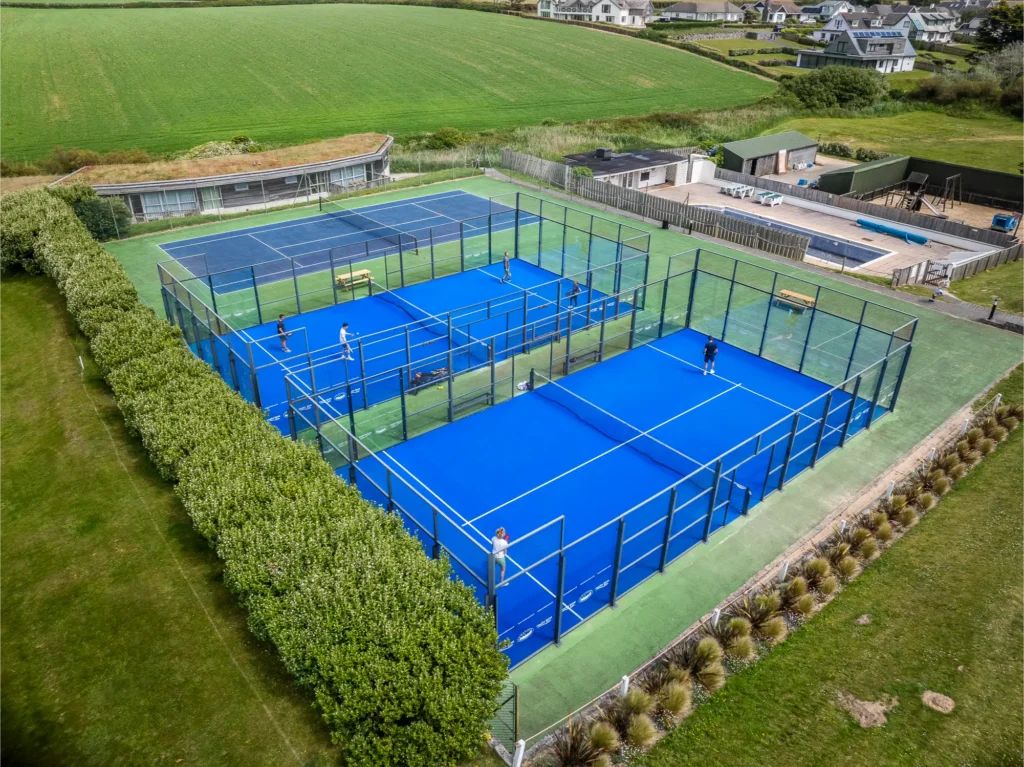
Padel is played on a 20m x 10m court divided by a net. The court is enclosed by glass walls (which you can play off) and metal fencing at the back and sides. Four players compete (two per team), and the objective is the same as tennis: win points by making shots your opponents can’t return.
The smaller court size means shorter points, more rallies, and constant action. Games are scored like tennis (15, 30, 40, game), and matches typically consist of the best of three sets. What sets padel apart is how the walls become a strategic element – a ball can bounce off glass and come back into play, creating shots impossible in traditional tennis.
Padel vs Tennis: Key Differences
While padel borrows tennis’s scoring system and court divisions, the similarities end there. These differences make padel easier to learn than tennis while offering genuine strategic depth.
- The serve is underhand (not overhand).
- A padel court is roughly a quarter the size of a tennis court.
- Unlike tennis, a padel court is fully enclosed. Walls are in play on your own side
- Padel is doubles-only
- Padel racquets are solid (not strung like tennis racquets)
The Padel Court Layout
The padel court is a precisely defined space that becomes your playing arena. Understanding its layout is essential because the walls and markings directly influence how points are won and lost. And that enclosure is fundamental to the game.
Court Dimensions & Markings
- A padel court measures exactly 20 metres long and 10 metres wide, with a net positioned at the centre dividing the court into two equal 10m x 10m halves.
- The net sits 88 centimetres high at its centre. Each half is divided into two service boxes – just like tennis – by a service line running parallel to the net. These boxes are 6.95 metres from the net line.
- The baseline (back line) is where serves originate, and all court markings are white lines.
- The walls are typically 3 metres high, with metal mesh fencing extending another metre above
Walls, Glass, and How They Work
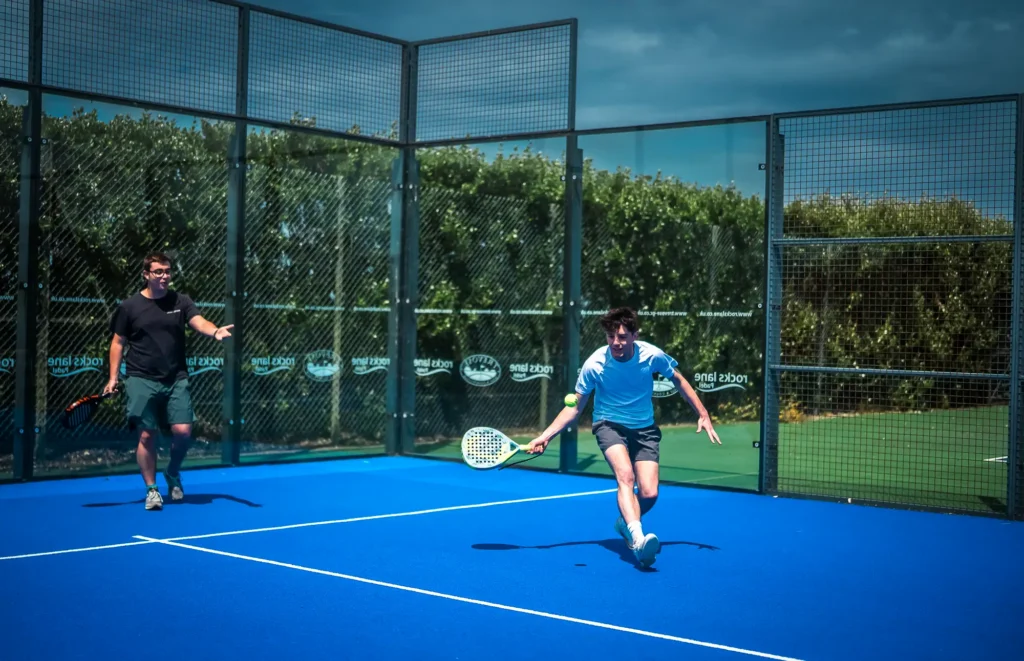
A padel court is surrounded by glass walls on the sides (running the full length) and a combination of glass and metal fencing at the back. These walls are in play on your own side – you can hit the ball against them, and if it bounces back into your court, you can continue the rally.
On the opponent’s side, if the ball hits the wall directly (without bouncing first in the court), it’s considered “out” and your opponents win the point. The glass allows visibility and creates unique angles for shot-making – one of padel’s most distinctive features.
Padel Rules for Service Boxes
The service boxes are the rectangular areas where serves must land. These boxes are where rallies begin, making accurate serving crucial to controlling the game.
Service boxes are located in front of the service line on each side of the court, positioned diagonally across from the server (just like tennis). The server stands behind the baseline on one side and must hit the ball so it lands in the diagonal service box on the opponent’s side. If the serve bounces in the service box and then hits the side or back wall, it’s still a valid serve – the opponent must return it. If the serve touches the net but lands in the service box, it’s called a “let,” and the server gets another attempt without penalty.
Padel Serving Rules
The serve is arguably the most distinctive aspect of padel – it’s fundamentally different from tennis and sets the tone for every point. Mastering the correct serving technique is essential because illegal serves result in faults, and two faults in succession mean losing the point.
How to Serve in Padel
The server stands behind the baseline on either the right or left side of the court and must serve diagonally into the opponent’s service box – the same diagonal pattern as tennis. The ball must land in the service box opposite; if it bounces beyond the service line or directly hits the back wall without bouncing first in the box, it’s a fault.
Importantly, the server has two attempts to make a legal serve. If both serves fail, the point goes to the opposing team. After each point, the serving player alternates sides (right to left, left to right). The serve is the only time a player initiates play, making accuracy and consistency vital.
Underhand Serve Requirements
Unlike tennis’s overhand serve, padel requires an underhand serve. The server must stand behind the baseline with at least one foot on the ground and strike the ball below waist height. The ball must bounce once on the ground before being struck (you cannot hit it directly out of your hand). The racquet cannot be swung above waist level.
These restrictions might seem limiting, but they actually promote longer rallies and more accessible play.
Common Serving Faults
A fault occurs when the serve fails to meet the legal requirements. The most common serving faults include:
- Hitting above waist height – The racquet must stay below the waist when striking the ball
- Hitting before the bounce – The ball must bounce once on the ground; hitting it in the air is illegal
- Landing outside the service box – If the serve lands behind the service line or outside the diagonal box, it’s a fault
- Direct wall contact – If the serve hits the back or side wall directly (without bouncing in the box first), it’s out
- Foot fault – If your feet cross or touch the baseline before striking the ball, it’s a fault
- Two consecutive faults – Miss twice in a row, and you lose the point
Each fault counts toward two total – after the second fault, the point is awarded to the opposing team.
Net Lets & Replays
If the serve touches the net cord during its flight but still lands in the service box, it’s called a “let.” When a let occurs, the serve is replayed without penalty – the server gets another attempt as if the fault didn’t happen.
However, if the serve touches the net and fails to land in the service box (lands outside or in the wrong box), it’s a regular fault and counts toward your two-fault limit.
The let rule applies only to serves – during regular play, the ball can touch the net and still be in play as long as it lands in the opponent’s court.
Padel Scoring System Explained
Padel uses the same scoring system as tennis, which makes it easy to learn if you already know tennis – and straightforward to pick up even if you don’t. Points accumulate within games, games accumulate within sets, and sets determine match winners.
Points & Games (15, 30, 40, Game)
Each point won in a rally is awarded a value: the first point is 15, the second is 30, the third is 40, and the fourth point wins the game. The sequence is always called out as: 15-0, 15-30, 30-40, etc., with the server’s score stated first. Once a player reaches 40 and wins the next point, that player wins the game – unless both players have won three points each, which triggers “deuce.”
Deuce & Advantage
When both teams have won three points each (40-40), the score is called “deuce.” From deuce, one team must win two consecutive points to claim the game. The first point won after deuce is called “advantage” (advantage to whoever won that point). If the team with advantage wins the next point, they win the game. If they lose it, the score returns to deuce. This continues until one team achieves a two-point lead.
Winning a Set
To win a set, a team must win six games with at least a two-game lead. For example, 6-4, 6-3, or 6-2 all win the set. If the score reaches 5-5, one team must win 7-5 to take the set. If the score reaches 6-6, a tie-break is played instead.
Tie-Breaks (Golden Point)
When a set reaches 6-6, a tie-break is played using a simple numeric counting system (1, 2, 3, 4, 5, 6, 7…) rather than 15, 30, 40. The first team to reach 7 points with at least a two-point lead wins the tie-break and the set. Many professional circuits now use the “golden point” rule at deuce in tie-breaks – instead of playing out multiple points, a single deciding rally determines the winner. This keeps matches moving and adds dramatic finality.
Match Format (Best of 3 Sets)
Most padel matches follow a best-of-three sets format. This means the first team to win two sets wins the match. A match could end 2-0 (two sets to nil) or 2-1 (two sets to one). Best-of-three is the standard in recreational and competitive play, balancing gameplay length with competitive integrity.
8 Core Playing Rules
Beyond the serve, the rules of padel govern how rallies develop, where the ball can be played, and when points are won or lost. These rules govern the game’s flow and define fair play.
1. The Two-Bounce Rule
The ball can bounce only once on your side of the court before you must hit it. If the ball bounces twice on your side without being struck, you lose the point. This rule keeps play dynamic and prevents players from letting balls settle. You can volley the ball (hit it in the air) at any time during play – you don’t have to wait for the bounce – but if you choose to let it bounce, it can only bounce once.
2. Ball Volley & In-Play Rules
The rules of padel state that you can hit the ball in the air before it bounces – this is called a volley and is a fundamental padel technique. Once the serve has been returned, the ball is “in play,” meaning it can touch the net and net posts as long as it lands in your opponent’s court.
However, if the ball hits the net and doesn’t clear to the opponent’s side, your opponents win the point. The ball must clear the net and land in the opponent’s court (or bounce off their walls) to remain in play.
3. Using the Walls (Glass & Fencing)
On your own side of the court, you can hit the ball against the glass walls and fencing at any time during the rally – before or after the bounce. If the ball bounces off your wall and returns to your side, you can hit it again. This creates opportunities for defensive and offensive shots.
However, on your opponent’s side, if the ball hits their wall directly without bouncing first in their court, it’s considered “out” and you win the point. The walls are a strategic asset on your own side but a boundary on theirs.
4. Playing Outside the Court
If your opponent hits the ball hard and it flies outside the court boundaries, you’re allowed to run outside and play it back in – as long as you make contact with the ball before it bounces a second time outside the court. This is one of padel’s most exciting features and requires significant court space around the padel court (minimum 2m x 5m for competitive play). You can “save” a point that appears lost by sprinting outside and returning the ball. However, this is only possible if there’s adequate space and your opponent’s shot was genuinely out of bounds.
Common Faults & Padel Rule Violations
Beyond serving faults, several rule violations result in losing the point during active play. These are the mistakes most commonly made by new players.
5. Touching the Net
If you touch the net with your racquet, body, clothing, or even hair while playing a point, you automatically lose the point – even if your shot was brilliant. This is one of the most frequently broken padel rules, often unintentionally.
6. Double-Hitting the Ball
You cannot hit the ball twice with a single swing, whether intentionally or by accident. If the racquet makes contact with the ball twice in one motion, your opponents win the point. Each shot should be a single, clean contact – if you mishit, you simply miss the shot rather than attempting a corrective second hit.
7. Feet Violations
Your feet must remain behind the baseline when serving. If either foot crosses or touches the baseline before you strike the serve, it’s a foot fault and counts as a fault. Additionally, you must maintain at least one foot on the ground when serving – jumping or leaving both feet is illegal. During regular play (non-serve), there are no foot violations, but poor footwork can still result in other faults like touching the net or hitting the ball before it crosses the net.
8. Hitting Before the Ball Crosses the Net
You cannot reach over the net to hit the ball on your opponent’s side unless your natural swing motion carries you over the net after making contact on your own side. Deliberately striking the ball while it’s still on the opponent’s side of the net results in losing the point.

Wall Play & Rebounds
Wall play is what truly distinguishes padel from tennis. Mastering when and how the ball can interact with the walls is essential to developing your game and understanding padel’s unique dynamics.
When the Ball Can Touch the Walls
On your own side of the court, the ball can touch the glass or fencing at any point during a rally – after bouncing, before bouncing, or even multiple times in succession. A ball can bounce off the ground, then the wall, then back into play, and you can hit it again. The walls essentially give you an extra playing surface.
On your opponent’s side, the ball can only touch the walls after bouncing in their court first. If it touches their wall without bouncing in their court, it’s out, and you win the point.
Direct Wall Hits (Out Rule)
If a shot you make hits your opponent’s wall directly – without bouncing in their court first – the ball is automatically “out” and you win the point. This is true for both the side walls and the back wall on the opponent’s side.
Conversely, if your opponent’s shot hits their own wall directly without bouncing in your court, you win the point.
Bouncing Off Walls Strategically
Skilled players use walls defensively and offensively. A defensive lob that bounces high and hits the back wall can become difficult to attack. An offensive player can angle shots into the side wall to create sharp angles. Some shots deliberately aim for the glass to redirect the ball past opponents. These wall shots require practice to control, but they’re a core part of advanced padel strategy.
What About the Smash?
The smash is one of padel’s most exciting shots – an overhead power stroke that can finish a point instantly when executed correctly.
How Smash Shots Work in Padel
A smash is an overhead shot hit with power, typically used when a lob or high ball lands near your side of the net. You position yourself underneath the ball, jump or reach upward, and strike it down into your opponent’s court with maximum force. The goal is to hit a winner – a shot your opponents cannot return.
When Smashes Are Legal
Smashes are legal at any time during active play when the ball is on your side of the court and within reach. There are no restrictions on smashing – you can smash from any position, at any height, and at any point in the rally. A smash is a scoring opportunity, but only if it lands in the opponent’s court.

Padel Equipment Rules
Official padel equipment must meet specific standards to ensure fair play and consistency across recreational and competitive levels. These specifications are governed by the International Padel Federation (FIP).
Racket Specifications
Padel racquets are solid-faced and made from composite materials such as carbon fibre or fibreglass. The combined length of the head and grip cannot exceed 45.5 centimetres. The face of the racquet must not be wider than 26 centimetres or thicker than 38 millimetres. There are no restrictions on the weight of the racquet.
Padel Ball Standards
Padel balls are slightly pressurised (unlike tennis balls) and have less bounce than tennis balls, which contributes to the slower, more controlled pace of the game. Padel balls are rubber spheres with a uniform outer surface, available in white or yellow.
Padel balls must:
- Measure between 6.35 and 6.77 centimetres in diameter
- Weigh between 56.0 and 59.4 grams
These specifications ensure consistent play across all courts and competitions.
What Clothes Should I Wear for Padel?
There are no official restrictions on padel clothing – players typically wear comfortable athletic wear similar to tennis. However, proper footwear is essential: padel-specific or tennis court shoes with good lateral support and grip are recommended, as the game involves quick directional changes.
Ready to Play Padel at Trevose?
Now that you understand the rules of padel, the next step is simple – step onto the court and enjoy! We offer modern padel facilities set against the backdrop of the North Cornwall coast. Whether you’re playing for the first time or looking to develop your game, our padel courts and coaches are here to support you.
Book a Padel Court
Padel courts at Trevose are available for hourly bookings, accommodating both beginners and experienced players. All bookings are made through the Playtomic App (iOS & Android). Simply download the app, set up your profile, and you’ll be ready to book courts, connect with players, and enjoy padel at Trevose.

Padel FAQS
What are the rules for padel?
Padel is played 2v2 on a 20m x 10m court surrounded by walls. Serve underhand diagonally, score like tennis (15-30-40), and win four points with a two-point lead to win a game. You can use the walls on your own side; the ball can bounce only once on your side before you hit it. First team to win two sets wins the match.
How does the scoring system work in padel?
Points are 15, 30, 40, game (same as tennis). At 40-40, it’s deuce – win two consecutive points to claim the game. Win six games with a two-game lead to win a set. If it reaches 6-6, play a tie-break (first to 7 points with a two-point lead).
Can you hit the serve overhand in padel like you do in tennis?
No. Padel requires an underhand serve. The ball must bounce once before you strike it, and you must hit below waist height. This makes the serve more accessible and encourages longer rallies.
Are you allowed to hit the metal in padel?
Yes, on your own side. You can hit the ball against glass walls and metal fencing freely. However, if a ball hits the opponent’s wall directly (without bouncing in their court first), it’s out and you win the point.
What’s the difference between a “let” and a fault in padel?
A let only applies to serves: if the serve touches the net but lands in the service box, it’s a let and you replay the serve without penalty. A fault is any illegal serve that counts toward your two-serve limit.
Can you hit the ball directly against the wall without it bouncing first?
On your own side, yes – you can hit the ball against the wall anytime, bounced or unbounced. On the opponent’s side, the ball must bounce in their court before touching a wall; direct wall contact means it’s out.
Is it a fault if the ball touches the net during play (after the serve)?
No. During active play, the ball can touch the net and net posts. As long as it lands in your opponent’s court, play continues. The net is only a fault line on serves.
Can you run outside the padel court to hit the ball back in?
Yes. If your opponent’s shot goes outside the court, you can run outside and return it before it bounces a second time. This requires adequate space around the court and is one of padel’s most exciting features.
What is the “golden point” rule in padel?
The golden point is used in professional padel when the score reaches deuce. Instead of playing multiple advantage points, a single deciding rally determines the winner. This keeps matches moving and adds dramatic finality.
Where can i play padel in Cornwall?
Trevose Golf and Country Club in Constantine Bay, Padstow, is one of Cornwall’s premier padel venues. Set on the North Cornwall coast, Trevose offers modern, well-maintained courts with flexible booking for recreational and competitive players.